Remember that impossibly long song about the Twelve Days of Christmas? I never understood it as a kid, because we only had one day of Christmas. It seemed more like a song teachers made up to keep us busy when we were too excitable to learn. But there are indeed twelve days of Christmas, and today is the official start. Here are the Christmas readings:
Isaiah 52:7-10
Psalm 98
Hebrews 1:1-12
John 1:1-14
You can read them here.
Saturday, December 25, 2010


Friday, December 24, 2010
Advent: Christmas Eve
Advent is a time of preparation, getting ready to celebrate the birth of Christ. The last day of the Advent season is Christmas Eve. It's one of those special days of focus, with these as lectionary readings:
Isaiah 62:6-12
Psalm 97
Titus 3:4-7
Luke 2:1-20
You can read them here.
Isaiah 62:6-12
Psalm 97
Titus 3:4-7
Luke 2:1-20
You can read them here.
Wednesday, December 22, 2010
Identity
"Who are you?"
There are many ways to answer this question, defining oneself by family relationships, friendships, work roles, culture, gender, ethnicity, preferences, skills, education, personality traits, sports teams, physical appearance, and so much more. These can be an important to a sense of identity, and are certainly part of God's unique creative work in each of us. But such descriptions cannot reach to the core.
Paul's letter to the Romans is an incredible work, articulating the foundations of grace, faith, and righteousness. How does he begin such a letter? He starts with the character of God and then his own identity in Christ. Paul knew he was a servant, an apostle, set apart for God, one who has received grace. His identity was in Christ, and only from that perspective could he begin to proclaim the gospel.
I am reminded of Jesus' words in John 13: "Jesus knew that the Father had put all things under his power, and that he had come from God and was returning to God; so he got up from the meal, took off his outer clothing, and wrapped a towel around his waist." He took on the menial role of a servant who would customarily wash the feet -- likely they were dirty and smelly from walking along dirt paths -- of the guests before a meal. Jesus knew who he was and he did not serve in spite of recognizing his divine nature, but because of it.
When we see clearly who God is, and who He invites us to be in Him, we create space for His transforming work to bring about great fruit in our lives.
Saturday, December 18, 2010
Advent: Week 4
December 19 is the fourth Sunday of Advent. Lectionary readings:
Isaiah 7:10-16
Psalm 80:1-7, 17-19
Romans 1:1-7
Matthew 1:18-25
You can read them here.
Isaiah 7:10-16
Psalm 80:1-7, 17-19
Romans 1:1-7
Matthew 1:18-25
You can read them here.
Thursday, December 16, 2010
Heart in the Bible
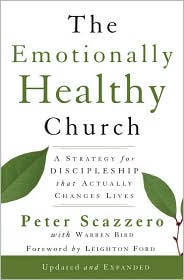
As it turns out, no, that is not all that really matters.
The Bible talks a lot about the heart. For example, the Sermon on the Mount is filled with "You have heard it said [behavior], but I tell you [about the underlying heart issue]." It addresses such topics as worry, grief, and anger. Paul's famous description of love in I Corinthians 13 includes many feeling words. And, of course, the Psalms give voice to a tremendous variety of human emotion.
Scazzero's writing has been challenging me quite a bit lately. My tendency, like many in the Church, is to focus on intellect and behavior while neglecting the heart. But to refuse to bring my emotional side to God for examination is to make a part of myself off-limits to God, closing myself off to His sanctifying work.
Sunday, December 12, 2010
Bringing Gifts
When I was a child, we used to cut the annual gift catalogs into strips and make colorful paper-chain garland out of them. Such mess-making destruction was normally frowned upon, so it felt like a fabulously fun privilege, and a little artsy, too. Looking back now, I like the symbolism of creating nearly-free tree decorations while destroying catalogs intended to entice us toward spending money.
When I was a child, I learned the story of Christmas. We heard about Mary and Joseph, the innkeeper, the shepherds, and various other characters. (Of the various parts I played in the various Christmas plays, my favorite was the camel. I don't remember whether it was a talking camel, but it was definitely a singing one.)
 Among the characters of Christmas were the Magi, a.k.a. Wise Men. Christmas plays usually showed three of them, each carrying a gift to Jesus -- gold, incense, and myrrh. When I was a child, I didn't understand this. I thought about the toys in the Christmas catalogs, and the "wise men" didn't seem too smart to me. After all, who gives perfume and embalming materials to an infant?
As an adult, though, I have learned some of the symbolism and value of those gifts, and realize they were far more significant than a fun plastic toy. In addition to their practical value for a struggling family, they were appropriate gifts for the King and foreshadowed the sacrificial death of Jesus.
When I was a child, I did not recognize the value of the gifts brought by the Magi many years ago, or by my friend more recently. As as adult, though, as I approach God in this Advent season, I want to give the gift of genuine love described in I Corinthians 13: "Love is patient, love is kind. It does not envy, it does not boast, it is not proud. It is not rude, it is not self-seeking, it is not easily angered, it keeps no record of wrongs. Love does not delight in evil but rejoices with the truth. It always protects, always trusts, always hopes, always perseveres. Love never fails..."
Love for his people -- all people -- is a great gift for our King.
When I was a child, I learned the story of Christmas. We heard about Mary and Joseph, the innkeeper, the shepherds, and various other characters. (Of the various parts I played in the various Christmas plays, my favorite was the camel. I don't remember whether it was a talking camel, but it was definitely a singing one.)

As an adult, though, I have learned some of the symbolism and value of those gifts, and realize they were far more significant than a fun plastic toy. In addition to their practical value for a struggling family, they were appropriate gifts for the King and foreshadowed the sacrificial death of Jesus.
As we were talking about getting ready for Christmas, a friend of mine described wanting to offer a gift to Jesus, like the Wise Men did. It brought up the question: What would be an appropriate and desirable gift for the King? This friend of mine talked personally about a shift in attitude that would be a very good gift for Christ this year. When I was a child, I may have suggested a gift that was flashier, more fun, because "When I was a child, I talked like a child, I thought like a child, I reasoned like a child..." (I Corinthians 13:11)
Love for his people -- all people -- is a great gift for our King.
Saturday, December 11, 2010
Advent: Week 3
December 12 is the third Sunday of Advent. Lectionary readings:
Isaiah 35:1-10
Psalm 146:5-10 or Luke 1:47-55
James 5:7-10
Matthew 11:2-11
You can read them here.
Isaiah 35:1-10
Psalm 146:5-10 or Luke 1:47-55
James 5:7-10
Matthew 11:2-11
You can read them here.
Subscribe to:
Posts (Atom)